


Cargill
Rapeseed Coconut Wax for Container Candles and Scented Melts 'NatureWax® 660-55M'
Rapeseed Coconut Wax for Container Candles and Scented Melts 'NatureWax® 660-55M'


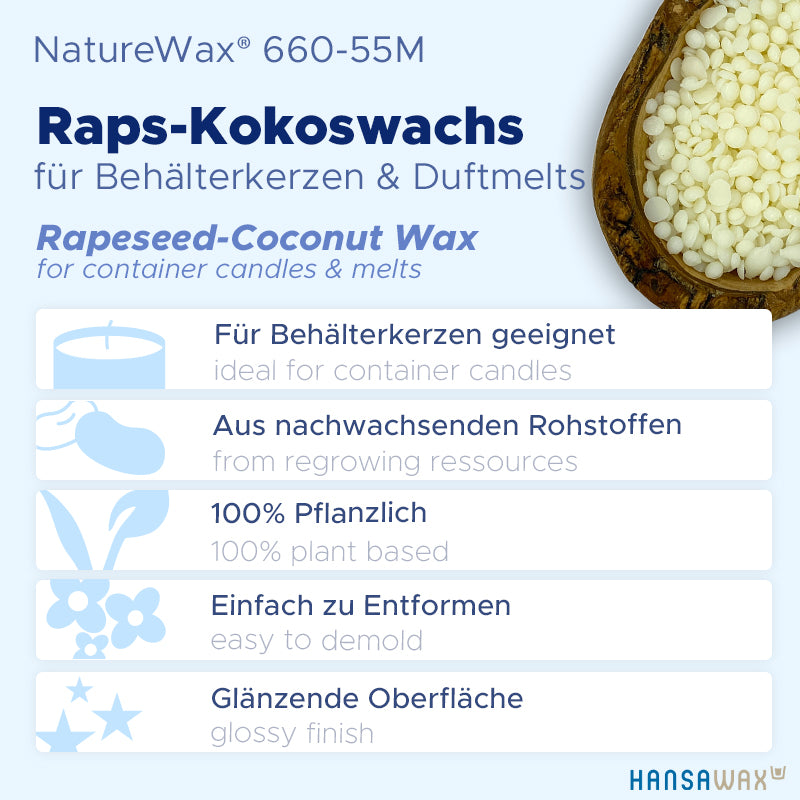
'Cargill NatureWax® 660-55M' is a high-quality candle wax made from 55% rapeseed wax and 45% coconut wax. The rapeseed oil comes from the EU, and the wax is manufactured in Hamburg, Germany. This plant-based blend impresses with its high thermal stability, excellent fragrance throw, a smooth, glossy surface, and excellent demolding properties – ideal for wax melts, tea lights, and small scented candles.
NatureWax™ 660-55M is free of paraffin, animal products, and genetically modified raw materials. Furthermore, the wax is Kosher and Halal certified and meets the requirements of RAL-GZ 041 (German Quality Association for Candles) for high-quality candle raw materials.
Important application recommendations
Important application recommendations
- The recommended melting temperature is approx. 75°C
- If possible, preheat the candle containers/molds to the pouring temperature (approx. 50-60°C) of the candle wax before pouring
- The optimal pouring temperature is approx. 50-60°C
- The fragrance absorption capacity is approx. 8-10%
- Allow the candles to cure for at least 48 hours at approx. 25°C after pouring
The candle wax must not be heated above 85°C, as otherwise important ingredients will be lost, which are essential for hardening, fragrance and color absorption, among other things. When curing, it is essential to avoid a sharp drop in temperature and drafts.
Technical Details at a Glance
Technical Details at a Glance
- Form: Pastilles
- Color: White to light yellow
- Melting Point: approx. 50°C
- Fragrance Load: approx. 8-10%
- Recommended Pouring Temperature: approx. 50-60°C
- Country of Origin: Hamburg
- GMO-Free (Except C3 Flakes)
- Free from mineral oil paraffins
- 1000g of candle wax in pastille form corresponds to approximately 1250ml of liquid candle wax
Price advantages for quantities from 100kg
Price advantages for quantities from 100kg
Are you looking for price advantages for larger purchase quantities or an attractive bulk price for (candle) raw materials? We offer attractive price advantages for bulk quantities starting from an order quantity of 100 kg.
Especially for smaller businesses, candle manufacturers and commercial customers, as well as diaconal institutions and workshops for people with disabilities, who regularly require larger quantities, an inquiry is worthwhile – we will be happy to provide you with an individual offer with attractive bulk prices.
If you are interested in bulk quantities, volume prices or long-term delivery conditions for candle wax, fragrance oils or raw soap, you can easily contact us via our contact form for bulk prices: To the contact form for bulk prices
We will review your inquiry and send you a personal offer for your desired quantity as soon as possible.
Packaging
Packaging
Cargill's candle waxes almost exclusively come in the manufacturer's box. The only exceptions are the pastille-shaped candle waxes, which come in a white bag and are then packed in a box for shipping.
Manufacturer's specification
Manufacturer's specification
Cargill B.V.
Evert van de Beekstraat 378
1118 CZ Schiphol
The Netherlands
Postal address
P.O. Box 75840
1118 ZZ Schiphol
The Netherlands
Tel +31 (0)20 500 60 00
Fax +31 (0)20 500 69 50
www.cargill.nl


You're supporting a young startup
In 2021, we decided to make high-quality and sustainable candle making materials available to everyone pursuing the hobby of candle making. Our products were to be without exception compatible with each other and easy to use. To this day, we have continuously developed our product range, so you can get everything you need from us to make sustainable and beautiful candles.

Help, Tools & Guides
The Hansawax help section bundles knowledge, experience, and practical instructions all about candle making. Clearly presented, continuously expanded, and straight from practice – for sound decisions and better results.
-

Our Idea
We exclusively offer candle waxes from natural raw material sources and package them in 100% recyclable paper bags. We complement this with high-quality candle dyes in flat pouches made from cornstarch and economical fragrance oils from German production in recycled brown bottles. By focusing on resource-saving packaging materials, we not only reduce waste and protect the environment, but also make an important contribution to sustainable trade.
-

Fast & Affordable
We place great importance on fair prices and fast shipping. Thanks to short supply chains through our producers in Germany and Europe, we can offer our products with a clear conscience. Most of our products are sourced directly from production without intermediaries. This allows us to offer our range at fair prices. If your order is received by us before 12 PM, it will usually be packed and shipped on the same day. Your package often reaches you the very next day.
-

Hansawax Guarantee
Compatibility, sustainability, and quality are our top priorities, because we are only happy when our customers are satisfied. Many have been loyal to us from the beginning, and for that, we are very grateful. If you have any questions about our products or your order, you can reach us via email, our contact form, or our social media channels Instagram and Facebook. We are always happy to help you.
Instructions
Our Guides for Your Candles
The Candle Pour

We want you to achieve the best results when making your custom candles. And that's very easy! Here you will find a small step-by-step guide.
What you need:
- stove
- Melting container (melting pot or melting jar)
- Wax thermometer
- Mixing spoon
- Wick centerer
- if necessary a cooking apron
Step 1:
Take a saucepan filled with water and place the melting container in it. Put your rapeseed or soy wax pallets into the melting container - you determine the amount depending on the size of the candle you want to make. Now you heat the water. It's best to use a wax thermometer and pay attention to the flash point . You should stir the wax every now and then with a mixing spoon until everything has melted.
Step 2:
In the meantime, take a wick and center it upright in the candle jar using the wick centerer . Of course, you can also prepare this step beforehand.
Step 3:
Add the intended amount of the selected fragrance oil to the liquid candle wax and stir it a few more times.
Step 4:
Now pour the candle wax into your candle jar until it is filled. Now all you need to do is let the candle wax cool down.
Complete!
The ratio of fragrance oil to candle wax
Scented candles are something wonderful and create peace, serenity and relaxation. Of course, a balanced proportion must be observed when pouring and mixing the scented candles. We therefore recommend the following quantities of fragrance oils:
- For a mild scent: 4 to 6 g per 100 g of candle wax
- For a pleasant scent: 7 to 8 g of fragrance oil per 100 g of candle wax
- For an intense scent: 10 g of fragrance oil to 100 g of candle wax
We strongly advise against adding more than 10 g, as otherwise the candle will “sweat out” the fragrance oil and this can lead to significant impairments in the burning behavior.
Flash point of the fragrance oils
The flash points (also called flash points) are always different depending on the fragrance oil. When the flash point is reached, important ingredients in the fragrance oil evaporate. This distorts the scent of the oil and significantly reduces the scent experience. We therefore recommend that you measure the candle wax using a candle wax thermometer observe and, if necessary, allow it to cool below the respective flash point.
Here you will find an overview of the flash points of all fragrance oils in our range:
- Raspberry Sorbet - 65°C
- Lemongrass Lavender - 77°C
- Frangipani - 77°C
- Cedarwood & Vanilla - 65°C
- Citronella - 53°C
- Salted Caramel Iced Coffee - 137°C
- Sandalwood - 65°C
- Patchouli Paradise - 122°C
- Honey & Milk - 99°C
- Matcha Tea Wild Honey - 100°C
- Coconut Bay - 72°C
- White Musk - 105°C
- Rose Jacarantha - 65°C
- Turkish Coffee - 65°C
- Cool - 85°C
- Black Lily - 85°C
- Pomegranate - 76°C
- Rosé Champagne - 85°C
- Gin Tonic - 74°C
- Cinnamon Cassia - 90°C
- Jamaican Rum - 93°C
- Christmas Cookies - 65°C
- Clean Cotton - 65°C
- Vanilla Bourbonesse - 75°C
Instructions for Use of Candles
• The visible wick should always be shortened to five to ten mm.
• Please keep the melted wax free of contamination.
• Please make sure that the candle burns for a maximum of four hours at a time.
• To avoid glass breakage, stop lighting the candle if there is approx. one to two cm of wax remaining.
• Be sure to avoid exposure to extreme temperatures.
• Please do not tilt or move the candles while the wax is liquid or the candle is burning.
• Smother the flame preferably with an extinguisher – blowing it out is not recommended.
• Please do not use any liquid to extinguish.
• The candle must not burn down without supervision.
TIP
To prevent the candle from burning in a tunnel shape, let the candle burn for at least one to two hours the first time you light it. The wax should be completely liquid on the surface. Have fun with your scented candle!
Troubleshooting
Bubble effect (bubbling effect)
Bubbles form in the wax, giving the candles a “spotty” appearance.
- The liquid candle wax was poured too hot in relation to the container/candle mold.
- The wax was agitated during the cooling process
- The candle wax may have been stirred/beaten too much while melting
-> Problem solution:
To avoid bubble formation, the liquid candle wax must be cooled down as much as possible so that it has a temperature as similar as possible to the candle container/mold. A good pouring temperature is, for example, 60-65°C - in this case the candle container/candle mold should be preheated to 50-60°C, for example in the oven. If possible, do not move the container/candle mold any more and ensure a room temperature of approx. 22-24°C - also avoid drafts and, above all, cold.
Tunneling Effect
The outside of the candle melts unevenly in relation to the inside of the scented candle
- The wick used is too small in relation to the size of the container: Please use a "larger" wick, see wick size information
-> Problem solving
Please do not dispose of the candles directly. You can melt the cast candle, for example, in a hot water bath or in the oven (if it is in a container) and reuse it directly for a candle with a larger wick. You can liquefy candle molds as usual in a bowl in a water bath.
Countersunk holes
Similar to the "bubble effect", "pits" or holes form on the surface of the candle.
- The wax was not heated to the correct temperature and/or poured at the appropriate temperature
- Or the wax was “disturbed” during the cooling process
- The candle wax was stirred too much
The scented candle or wick produces soot
- The wick may be too long - shorten it to a maximum of 1 cm
- The wick is “too large” in relation to the container
- Too many additives (fragrances, color, etc.) have been added. “Wrong” essential oils can also promote this.
The scented candle keeps going out:
- A wick that was too small in relation to the container was chosen
- Too many or incorrect color pigments have been added to the wax - too many pigments prevent the wick from burning.
Sooty fungus (mushrooming)
The wick curves and bends into the shape of a mushroom.
- A wick that was too large in relation to the container was chosen
The candle wax is broken or has cracks
- The candle was cooled too quickly.
-> Troubleshooting
Please leave the candle at room temperature (21°C) for at least 48 hours. Allow to harden - a temperature of 22 - 24°C is recommended. For a faster cooling process, please do not put the candle in the refrigerator, freezer or outside at low temperatures.
To repair cracks, you can use a hot hair dryer to melt the surface slightly.
The wax starts to burn in the melt
- Melting temperature too high:
Reduce the temperature of the water bath/pot to the recommended temperature (see wax instructions).
Congratulations, you now have a campfire and the fire department is probably (or hopefully?!) on the way!
The next time you try, we recommend reducing the temperature significantly. Please use a bowl placed in a water bath. This way you can ensure that the candle wax does not get hotter than 100°C (80°C is optimal). We recommend using a thermometer for this.
Irregular patches of color in the wax ( haze or spots)
- Too much or too little color pigment may have been added to the melted wax
- Color pigments in the liquid candle wax have not dissolved properly
-> Problem solving
Sometimes the melted candle wax looks as if all the color pigments have dissolved and the candle wax is ready to be poured. But that can be misleading. Undissolved pieces cause an unsightly haze when pouring - too few color pigments, on the other hand, cause unsightly stains because there is not enough pigment for the entire candle wax. We therefore recommend weighing the color pigments with a fine scale and giving them at least 5 minutes to liquefy in the liquid candle wax. This way you can ensure that your candle is the color you want.
Danger! More doesn't help in this case, but rather leads to the wick becoming clogged and the candle starting to soot. In addition, the candle only takes 48 hours. harden to its final color.
The color of the wax fades
- Basically every candle can fade in color. This usually happens through UV radiation. In industry, this is avoided by adding an additive (UV inhibitor).
-> Problem solving
To avoid fading, it is best to protect from UV rays and store in places protected from light.
Your problem wasn't listed here? Then please write us a message .